You know your alphabet, the sounds each letter represents and how the sounds blend to reflect the facts and feelings of your world. You have been “inside the code” for some time and reading gives you great pleasure. Images form in your mind and you are often transported from your uninspired life to somewhere much more engaging. There may have even been times when it felt that reading was your truest friend.
Now imagine trying to read but, inexplicably, the code has become impenetrable. Sometimes the words are just hollow black on white designs and sometimes the letters move around the page, seemingly of their own volition, often disintegrating into their component parts before your eyes. Like a bevy of blackbirds, the letters may strut around the page, lift off, flutter in a cloud-like murmuration, and settle back in a random array.
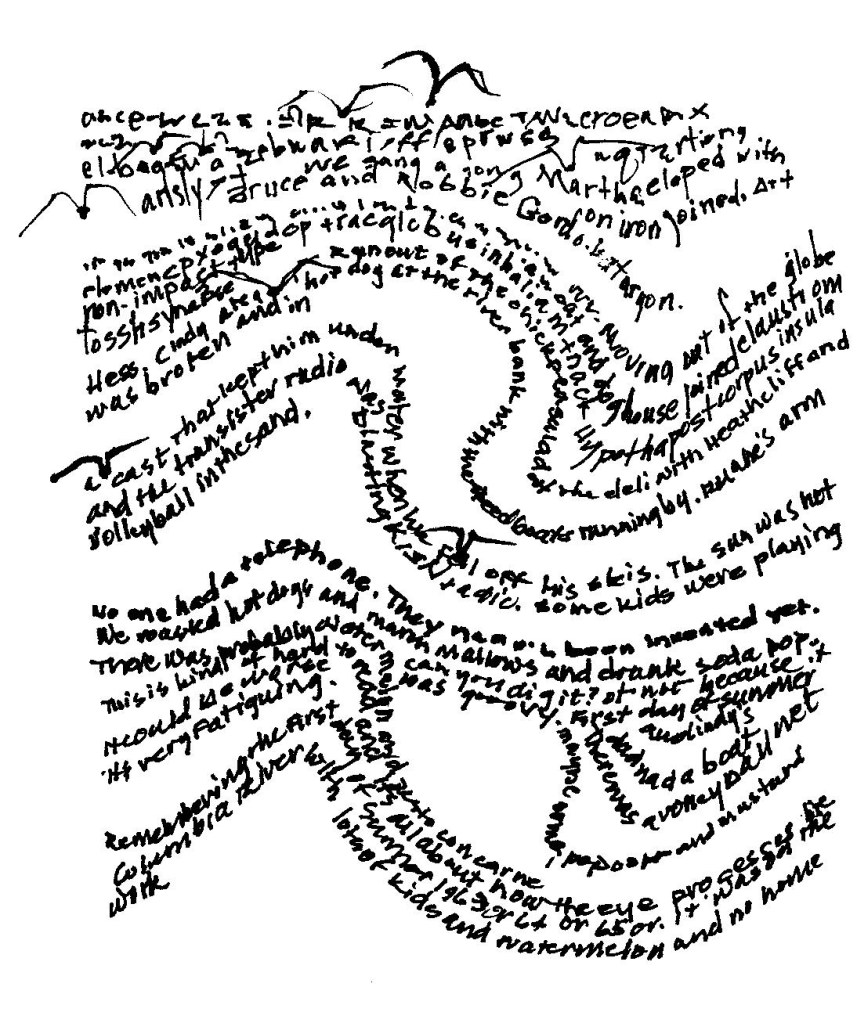
Reading often becomes almost impossible for an injured brain.
It’s estimated 90% of folks who have experienced a TBI will develop problems with their visual processing. For some the explanation is Scotopic Sensitivity Syndrome (SSS), also known as Irlen Syndrome. With SSS, the problem is not in the eyes themselves but in the neural pathways that run from the retina at the back of the eyeball to the visual field at the back of the brain. These pathways, magnocellular (M pathway) and parvocellular (P pathway), deliver signals to the visual field where they are decoded into color, motion, shape, and depth. Under ideal circumstances, the M pathway is speedier than the P pathway, each delivering appropriate “data” to the visual field where the signals are decoded and appear coherent. In less-than-ideal situations, the data is delivered “out of order”, resulting in visual chaos. Just what kind of chaos is dependent upon where in the pathways the disruptions are.
In previous posts, I’ve described the fragility and susceptibility of neurons that make up the gelatinous mass that is the brain. When that intricate architecture is disrupted by a jolt, blow, or high frequency shock wave, disruption of visual processing is often the result.
On the other hand, Irlen Syndrome may also occur in people who have no history of TBI. In such situations, it is often a familial or genetic problem.
Infringement on or loss of the ability to read the written word may not occur immediately following an injury. It can also be intermittent, occurring at times of increased stress, such as during test taking, or under specific circumstances, such as fluorescent lighting. The consequences of brain injuries can be confusing and not seem directly related to any injury – especially when it seems like someone “shook off” a supposedly minor incident.
We like to think of injuries as we think of colds – you get over them. A broken bone mends & is often stronger than it was before the break, so why shouldn’t the brain heal that way too?
As I have stated in previous posts, several sequelae of head injuries, such as sensory integration problems, migraines and fibromyalgia can take years to manifest and therefore seem totally unrelated to any injury. In my situation, no one predicted I could have problems so when they occurred, I made no association with the many knocks my noggin had sustained and assumed I was losing my mind. Frightened more by my imagination than by reality, I told no one. I felt I was faking my way through academics, always believing I was not as smart as my classmates. I never cheated, but I always felt I was fooling people when they complimented me on my accomplishments. Taking exams was the hardest because I could never tell whether I understood the questions. How I made it through school remains a mystery.
Scotopic Sensitivity was not identified until the 1980s, after I had improved my visual processing through other means. I don’t know for sure, but I think it may have been simpler for my brain to rectify my visual processing issues because I had been a successful reader before most of the TBIs. Perhaps the genetic form of SSS requires long-term or ongoing therapy. You can learn more about SSS/Irlen Syndrome by following these links: This is an “animated” explanation of SSS/Irlen Syndrome, and this is the personal story of a child who suffers from SSS.

 My Life in Brain Injuries
Leave a comment