The Day I Was Born.
I had been swimming in what Kotzwinkle called “the secret sea”, bathed in my mother’s heartbeat; feeling the pulse of the daily symphony of voices – Mom, sisters, Daddy and Skeeter, the dog. When I emerged, a forceps delivery because Mom was out, in “twilight sleep”, I was put in the nursery – a brightly lit room where no sound matched the world I had inhabited.
Studies have shown that newborns recognize and turn toward their mothers’ voices.
Separation of child from mother is now recognized by baby-centric care providers to be cruel for both mother and child, but it was the norm in mid-twentieth century American delivery rooms.
My mother was a traditionalist and had what I now consider to have been an unhealthy respect for authority. She was timid in the doctor-centered hospital setting, afraid of challenging more educated, knowledgeable people by asking to see her baby.
The family legend:
A nurse – a woman Mom knew from our little town – recognized my mother and asked, “Why Ruby Lewis! What are you doing here?”
I was the pregnancy Mom didn’t “show”. “I wore the same coat all the way through – right into the hospital!” she said with mixture of wonder and pride. I was full term with a healthy birth weight of over six pounds, but I nestled in her body without bringing attention to my presence. And Mom, prudish, would not have told anyone outside the family that she was pregnant. So, “Why Ruby Lewis! What are you doing here?” was a logical question.
Mom, feeling safe with a familiar face, asked, “What would you do if you had a baby and hadn’t seen it?”
And this is where the story thrilled me, every time she told it. “I’d tear this place apart.” To think someone would want me that much – to ransack a hospital!
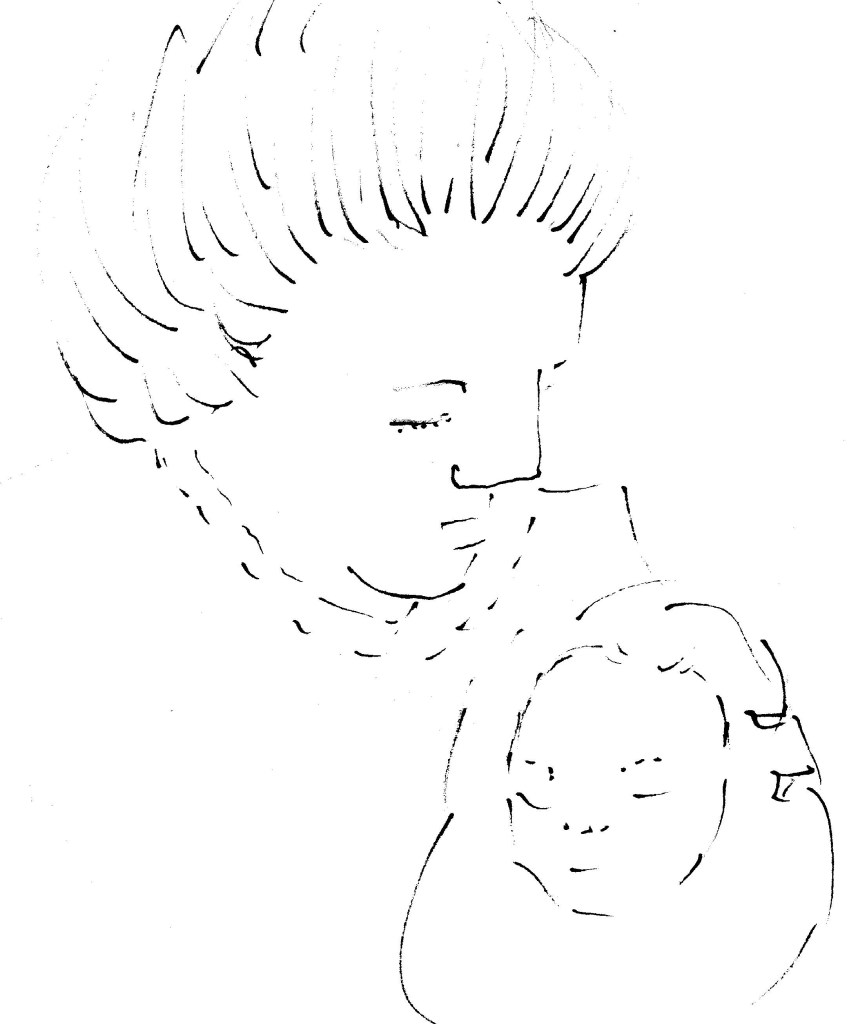
By the time the nurse tracked me down and handed me to my mother, I was eight hours old. Mom did an accounting of my fingers and toes, all present and in the right places, but she was dismayed to see my double crown, which, she was certain, would doom me to a life-long struggle with cowlicks, a curse for a girl. Double crowns along the length of their spines give Rhodesian ridgebacks their ridges – a great look on a hound, but perhaps not what a mother would hope for her daughter. She had no idea what had transpired under that double crown, past the scalp, beyond the skull, under three layers of dura in the previous eight hours.
Babies are born with a fully operational autonomic nervous system (ANS), the “automatic” aspect of the nervous system that is tasked with keeping us alive. The ANS keeps the vital organs doing their vital jobs – the heart pumping, the lungs breathing, the kidneys filtering, etc. – all without conscious effort. It also scans the scene for danger, and when things don’t fit together, it sets off alarms because the ANS is the home of “fight or flight”.
The newborn can neither fight nor flee.
By one hour after separation from its mother, a mammalian baby has increased crying by 1,000%. Scientists call it vocalization, but it is the sound of terror. Abandonment means death to the infant mammal.
In the second hour of separation, stress hormones have shot up, etching the brain with patterns of fear. Stress hormones such as cortisol act upon the glia of the brain, especially the hippocampus, like battery acid.
By three hours, she has given up crying. In those same three hours, growth hormones have dropped by as much as eighty percent. Despair has set in.
At eight hours, the pace of the release of stress hormones has slowed, but still, there has been a total increase of three hundred fifty percent and the brain is branded for life with fear as its first and deepest experience.
My story is nothing unusual for the time – mid-twentieth century babies were considered blank slates; empty vessels and there were so darn many of us. (I was born in the middle of a boom in the baby making business.) It was well understood that puppies separated from their mothers too early could not thrive and may not survive, but the dominant mid-twentieth century belief was that people were somehow above “animal” needs.

 My Life in Brain Injuries
Leave a comment