The central nervous system (CNS) is comprised of gray matter – mostly cell bodies – and white matter – mostly cell axons. Although the two “matters” look separate, they are unitary – continuous neurons. We think of the gray matter as being the outside of the brain, which it is, but it also exists in small islands inside the brain. Most people, if they’re honest about it, don’t think of the spinal cord as part of the CNS, but there the gray matter is primarily on the interior. Throughout the CNS, the gray matter is denser than the white matter. That becomes especially important when it comes to high-speed crashes.
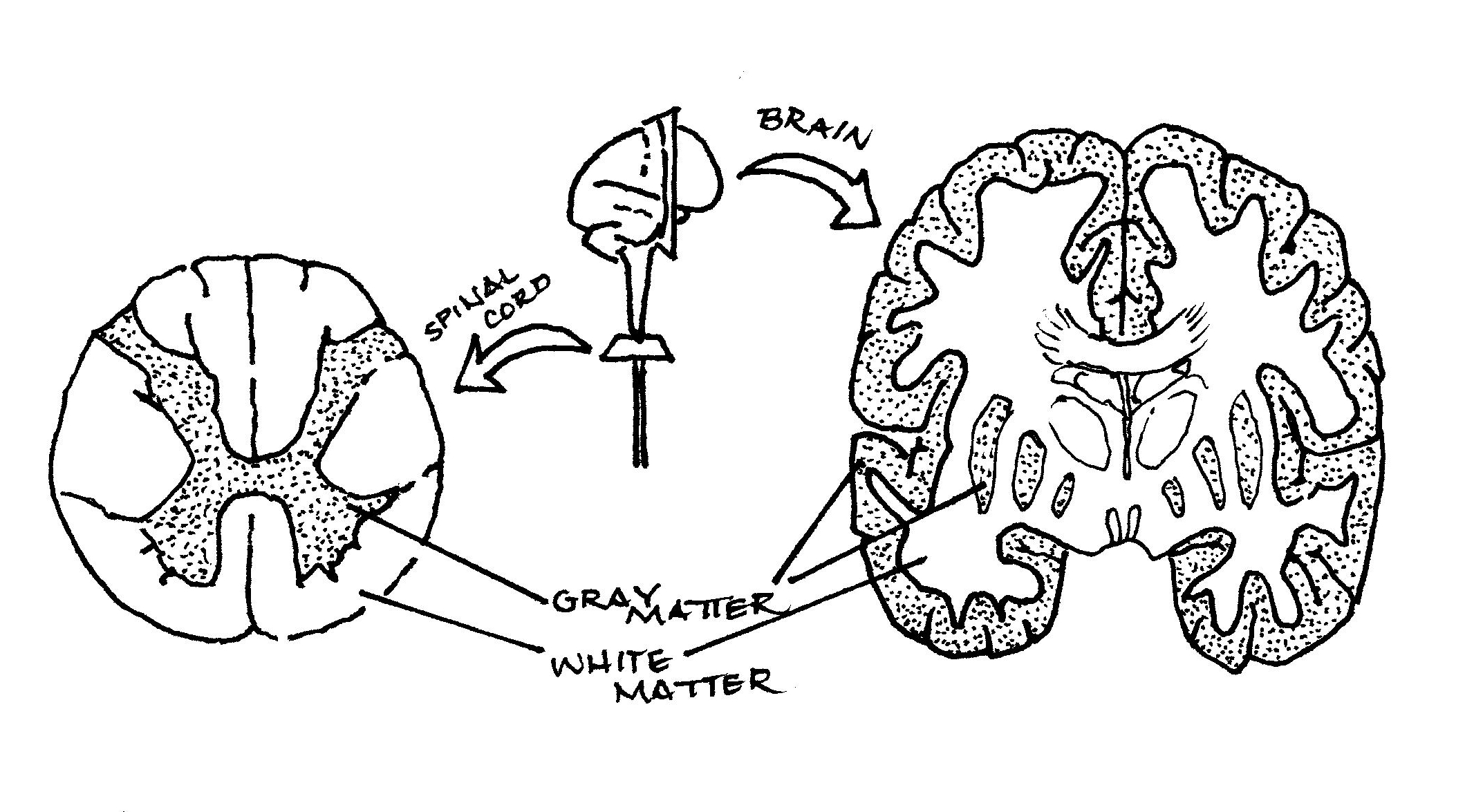
Our evolution over millennia occurred while we led pedestrian lives. I don’t mean that we were dull or lacking inspiration. I mean that if we wanted to go anywhere, we walked. We could run and jump but we couldn’t do anything, short of falling off a cliff, that moved us as fast as any of the cars now driving through my relatively bucolic neighborhood. Therefore, our evolution did not prepare us for car crashes. Neuronal damage, as I pointed out before, can occur at speeds as low as 3 miles per hour.
Whether the head hits an object (impact) or is “simply” whipped back and forth (nonimpact) the effect is rarely in only one or two directions. The brain also twists within the skull. The twisting pinches nerve fibers and small blood vessels. Some become varicose – still functional but compromised – while other fibers and vessels simply snap.
Even though the neuron is a unit, because the white matter is less dense than the gray matter, it will slide more easily than the gray matter. The sliding can occur throughout the brain and spinal cord, further pinching the axons; sometimes rupturing them, sometimes shearing them from the cell body. This is called diffuse axonal injuries (DAI). Two thirds of DAI occur where the gray matter meets the white matter.
At times the bruised axon degenerates from the distal end back towards the cell body. That’s called Wallerian degeneration and can take a long time to manifest. This is why some people may develop symptoms such as chronic pain (e.g., migraines) about five to seven years after a brain injury.
We may feel permanently altered due to our brain injuries, unable to fully function as we once did, but it is important to remember that even though compromised, the brain is still plastic and capable of learning. It still has a goal of efficiency and, with appropriate support, can improve in function.

 My Life in Brain Injuries
Leave a comment